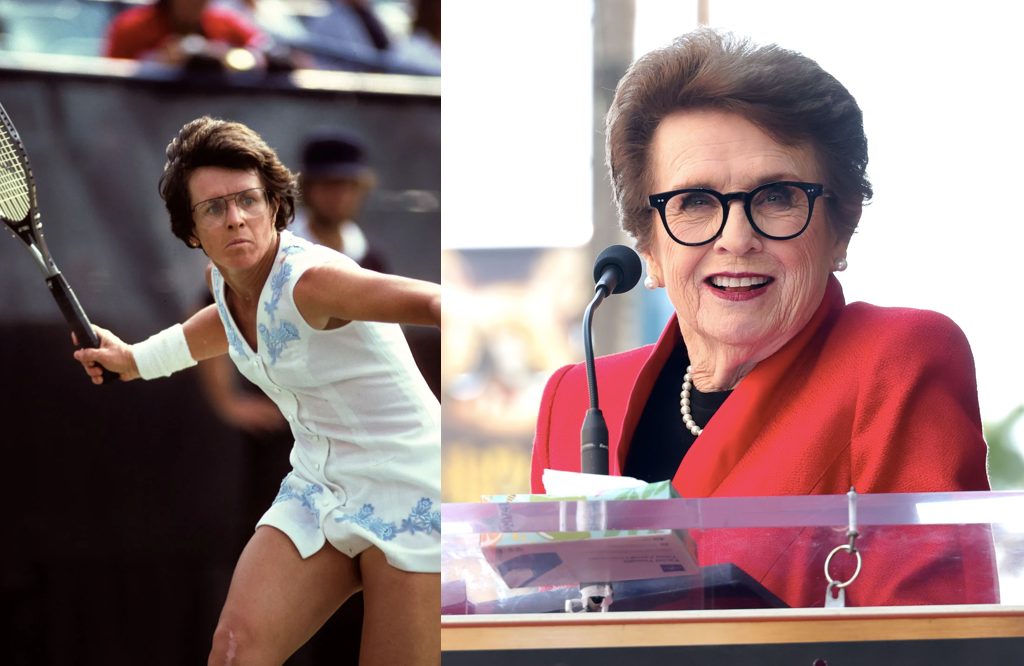
Billie Jean King biography — the story of the 39-Grand-Slam tennis legend who beat Bobby Riggs, founded the WTA, and reshaped sport for women everywhere.
The Quick Picture
- Born November 22, 1943 in Long Beach, California; turns 83 in November 2026
- Won 39 Grand Slam titles including a record 20 at Wimbledon, and defeated Bobby Riggs in the 1973 Battle of the Sexes before 90 million viewers
- Founder of the Women’s Tennis Association (WTA) and the Women’s Sports Foundation, and the only person to have a major Grand Slam venue and a global team competition (the Billie Jean King Cup) named after her
Who Is Billie Jean King?
Billie Jean King is, by almost any honest measure, the most influential figure women’s sport has ever produced. The 39 Grand Slam titles and the record 20 Wimbledon trophies would alone place her among the greatest tennis players of all time. The 1973 Battle of the Sexes victory over Bobby Riggs, watched by an audience of roughly 90 million people worldwide, would alone place her in the cultural history of the 20th century. The founding of the WTA, the campaign for equal prize money, and her role as the figure most associated with the passage of Title IX would alone make her one of the most consequential American activists of her generation.
She did all three. And she is still working.
At 82 years old in 2026, she remains a public voice, an investor in women’s sports, an author, and the only person in the history of American sport to have a Grand Slam venue, an international team competition, and a public library named in her honour during her lifetime.
Quick Facts: Get to Know Billie Jean King
| Detail | Information |
|---|---|
| Full Name | Billie Jean King (née Moffitt) |
| Date of Birth | November 22, 1943 |
| Age (2026) | 82 years old (turns 83 in November 2026) |
| Place of Birth | Long Beach, California, USA |
| Nationality | American |
| Religion | Raised Methodist |
| Father | Bill Moffitt (firefighter) |
| Mother | Betty Moffitt, née Jerman (homemaker) |
| Brother | Randy Moffitt (former Major League Baseball pitcher) |
| Education | Long Beach Polytechnic High School; California State University, Los Angeles (returned 2025) |
| Profession | Former tennis player, activist, businesswoman, author, investor |
| Years Active (Tennis) | 1959–1983 |
| Grand Slam Singles Titles | 12 |
| Grand Slam Doubles Titles | 16 (women’s) + 11 (mixed) = 27 |
| Total Grand Slam Titles | 39 |
| Wimbledon Titles | 20 (all-time record) |
| First Marriage | Larry King (married September 17, 1965; divorced 1987) |
| Current Wife | Ilana Kloss (former US Open doubles champion) |
| Sexual Orientation | Lesbian; publicly outed in 1981 |
| Hall of Fame | International Tennis Hall of Fame (1987); National Women’s Hall of Fame (1990) |
| Presidential Medal of Freedom | Awarded by President Barack Obama (2009) |
| Congressional Gold Medal | 2024 |
| French Legion of Honour | 2022 |
Early Life & Background
Billie Jean Moffitt was born on November 22, 1943 in Long Beach, California, into a Methodist family of modest means and uncomplicated values. Her father, Bill Moffitt, worked as a firefighter for the city. Her mother, Betty Moffitt (née Jerman), kept the home. The family was athletic and competitive. Her younger brother, Randy Moffitt, would go on to a 12-year Major League Baseball career as a relief pitcher with the San Francisco Giants, the Houston Astros, and the Toronto Blue Jays.
Billie Jean was the active, restless child in the family — the one who needed an outlet, who needed motion. She played softball before tennis. She played basketball. The decision to switch sports came at age 11, when her parents suggested she try something more “ladylike” than softball. Tennis, in the early 1950s, was that something.

The first conflict between Billie Jean Moffitt and the tennis establishment came almost immediately. At one of her earliest tournaments, she was excluded from a group photograph because she was wearing tennis shorts that her mother had sewn for her, instead of the traditional white tennis dress that the sport demanded of its young women.
She was, perhaps, ten years old.
Education
Billie Jean attended Long Beach Polytechnic High School, where she graduated in 1961, the same year she would win her first Wimbledon title in doubles. She then enrolled at Los Angeles State College, now California State University, Los Angeles, where she studied while continuing to compete and where, in 1963, she met Larry King in the campus library.
She left Cal State LA in 1964 to focus on her tennis career, without completing her degree. In a development that few might have predicted, she returned to Cal State LA in 2025, more than 60 years after first enrolling, with the intent of finishing the degree she had set aside to chase a world ranking.

Career: A Life on Both Sides of the Net
The Player: From Wimbledon Doubles to World Number One
Billie Jean King turned professional in 1959 under the coaching of former tennis great Alice Marble. She first attracted international attention in 1961, when at just 17 she partnered Karen Hantze to win the Wimbledon women’s doubles as the youngest pair ever to do so.
By 1966, she had captured her first Wimbledon singles title and achieved the world No. 1 ranking she had told her mother she would have when she was 11 years old.
What followed was 17 years of dominance:
- 39 Grand Slam titles in total: 12 singles, 16 women’s doubles, 11 mixed doubles
- A record 20 Wimbledon titles: 6 singles, 10 women’s doubles, 4 mixed doubles
- World No. 1 ranking in 1966, 1967, 1968, 1971, 1972, and 1974
- Career Grand Slam in singles (1972), only the fifth woman in history to achieve it
- Career Grand Slam in mixed doubles
- Wimbledon Triple Crown in 1973: singles, doubles, and mixed doubles all in one tournament
- 129 career singles titles across her professional career
Her last WTA singles title came on June 6, 1983 at the Edgbaston Cup in Birmingham, England, where at 39 years, 7 months, and 23 days she defeated Alycia Moulton to become, and remain, the oldest player ever to win a professional WTA Tour singles title.

The Battle of the Sexes (1973)
On September 20, 1973, in the Houston Astrodome, Billie Jean King played a tennis match that would define her place in cultural history.
Her opponent was Bobby Riggs, a 55-year-old former world No. 1 and self-proclaimed male chauvinist who had spent months publicly proclaiming that the women’s game was inferior, that he could beat any top female player even at his age, and that the entire idea of equal prize money was absurd. He had, weeks earlier, easily defeated Margaret Court in a similar match.
King won in straight sets: 6–4, 6–3, 6–3.
The audience was 30,492 in person and a televised audience of approximately 90 million worldwide. It remains, by some measures, the most-watched tennis match in history. The two became close friends in the years that followed. Riggs called King the night before he died in 1995.

The Activist: Founding the WTA and the Fight for Equal Pay
On September 23, 1970, King was one of nine players who broke away from the tennis establishment, signed $1 contracts with promoter Gladys Heldman, and competed at the Virginia Slims Invitational in Houston. The breakaway tournament, born of frustration over pay ratios between men and women, gave rise to the first Virginia Slims Circuit in 1971.
In 1971, King became the first female athlete in any sport to earn more than $100,000 in a single season.
Two years later, on the eve of Wimbledon 1973, King and roughly 60 other players gathered at London’s Gloucester Hotel to found the Women’s Tennis Association (WTA). She was elected its first president. From that platform, she lobbied successfully for the US Open to become the first Grand Slam to offer equal prize money to men and women that same year.
“I am going to be No. 1 in the world.” — Billie Jean King to her mother Betty, after one of her first tennis lessons, age 11
In 1974, she co-founded the co-ed World Team Tennis league and established the Women’s Sports Foundation, dedicated to expanding girls’ access to sport.

Career Timeline & Major Milestones
| Year | Milestone |
|---|---|
| 1943 | Born November 22 in Long Beach, California |
| 1954 | Began playing tennis at age 11 |
| 1959 | Turned professional; coached by Alice Marble |
| 1961 | Won her first Wimbledon title (women’s doubles) at age 17 |
| 1965 | Married Larry King in Long Beach |
| 1966 | Won first Wimbledon singles title; achieved world No. 1 ranking |
| 1971 | First female athlete to earn over $100,000 in a single season |
| 1972 | Won French Open; completed career Grand Slam; named Sports Illustrated Sportsperson of the Year |
| 1973 | Won Wimbledon Triple Crown; founded WTA; defeated Bobby Riggs in Battle of the Sexes |
| 1974 | Co-founded World Team Tennis and the Women’s Sports Foundation |
| 1981 | Publicly outed as gay in a palimony lawsuit |
| 1983 | Won final WTA singles title in Birmingham at age 39 |
| 1987 | Inducted into International Tennis Hall of Fame; divorced Larry King |
| 1990 | Inducted into National Women’s Hall of Fame |
| 1995–2003 | Coached US Fed Cup team (Fed Cup wins in 1999, 2000) |
| 1996, 2000 | Coached US women’s Olympic tennis teams to gold medals |
| 2006 | USTA National Tennis Center renamed in her honour |
| 2009 | Presidential Medal of Freedom from President Barack Obama |
| 2018 | BBC Sports Personality Lifetime Achievement Award |
| 2020 | Fed Cup renamed the Billie Jean King Cup |
| 2021 | Published autobiography All In; received Muhammad Ali Legacy Award |
| 2022 | Awarded the French Legion of Honour |
| 2024 | Awarded Congressional Gold Medal |
| 2025 | Returned to Cal State LA to complete her degree |
Key Takeaways
- King’s playing record alone, 39 Grand Slam titles and 20 Wimbledon trophies, would secure her place among the greatest in tennis history; everything beyond that is bonus
- Her activism produced concrete institutional change including the WTA, the Women’s Sports Foundation, and equal US Open prize money
- The Battle of the Sexes remains the most-watched tennis match ever played, and is taught in American cultural history courses alongside Title IX
- She is one of very few athletes to have both a Grand Slam venue (Flushing Meadows) and a global team competition (the BJK Cup) named after them
Personal Life: Marriage, Coming Out, and Ilana Kloss
Billie Jean met Larry King at Cal State LA in 1963. They became engaged the following year and married on September 17, 1965 in Long Beach. Larry was 19, Billie Jean was 21. She has long credited Larry with introducing her to feminism and with pushing her to take tennis seriously as a career rather than a hobby.
The marriage ended in divorce in 1987, but the friendship did not. The two have remained close.
In 1981, King’s life took a public turn she had not chosen. She was sued for palimony by her former secretary, Marilyn Barnett, with whom she had been in a secret relationship in the early 1970s. The lawsuit forced her public outing at a time when LGBTQ identity in professional sport was still treated as a career-ending stigma. She held a press conference and acknowledged the relationship, becoming one of the first openly gay major sports figures in American history. The financial and professional cost was enormous. Endorsement deals collapsed, and she has estimated the personal financial impact at roughly $2 million in 1981 dollars.

She has since spoken openly about how painful and traumatic the experience was, and about how much earlier she would have come out had the cultural and professional environment of the time allowed it.
Today, she is married to Ilana Kloss, a South African-born former US Open women’s doubles champion and longtime business partner. The two have been together for decades. With Ilana by her side, King has built a second-act career as a pioneering investor in women’s sports, sports technology, and equality-focused ventures.
What Is Billie Jean King’s Net Worth?
Billie Jean King’s net worth is estimated by various sources at approximately $20 million as of 2025–2026, drawn from a combination of her tennis career earnings, decades of speaking and endorsement work, book sales, business ventures, and her investment portfolio with Ilana Kloss.
It is worth noting that during her playing career, the prize money available to women was a small fraction of what comparable men earned, and that her 1981 outing cost her millions in endorsement income. Her current financial standing reflects decades of post-career work as a businesswoman, investor, author, and commentator far more than it reflects her tennis earnings alone.

These figures are third-party estimates and have not been independently confirmed by King or her team.
What Did Billie Jean King Do for Women’s Sports?
This is the question her entire post-1970 career was designed to answer. The honest, short version: she changed the financial, legal, and cultural conditions under which women could compete in professional sport — in tennis first, and in sport generally through the institutions she founded.
The specific, verifiable contributions include:
- Founded the Women’s Tennis Association (WTA) in 1973, which remains the governing body of women’s professional tennis
- Founded the Women’s Sports Foundation in 1974 to expand girls’ access to sport at all levels
- Won the campaign for equal prize money at the US Open in 1973, the first Grand Slam to offer pay parity
- Became the first female athlete to earn over $100,000 in a single season in 1971
- Was the public face of the Title IX era, which since 1972 has prohibited sex discrimination in any educational programme receiving federal funding, including school sports
- Became the first woman commissioner in professional sports history in 1984
- Established her own foundation in 2014 to advance equity through sports, education, and activism
Frank Deford, writing in Sports Illustrated, summed it up: “She has prominently affected the way 50 percent of society thinks and feels about itself in the vast area of physical exercise.”

Awards & Recognitions
Billie Jean King’s honours list is one of the longest of any American athlete in history. The most significant include:
- International Tennis Hall of Fame (1987)
- National Women’s Hall of Fame (1990)
- Sports Illustrated Sportsperson of the Year (1972, joint with John Wooden), the first tennis player and first woman to receive the honour
- Time Person of the Year (1975)
- USTA Billie Jean King National Tennis Center dedicated (2006), the first woman to have a major sports venue named in her honour
- Presidential Medal of Freedom (2009)
- BBC Sports Personality of the Year Lifetime Achievement (2018)
- Billie Jean King Cup, Federation Cup renamed in her honour (2020)
- Muhammad Ali Legacy Award (2021)
- French Legion of Honour (2022)
- Congressional Gold Medal (2024)
- Life magazine named her one of the “100 Most Important Americans of the 20th Century”, the only woman athlete on the list
Philanthropy: The Billie Jean King Foundation
In 2014, King founded the Billie Jean King Foundation (later sometimes known as the Billie Jean King Leadership Initiative), a non-profit dedicated to building a more equitable future through sports, education, and activism. The foundation has focused particularly on LGBTQ+ inclusion in workplaces and sport, on gender equity research, and on leadership development for under-represented communities.
She has also served as a director of the Elton John AIDS Foundation and the National AIDS Fund, building on her decades of public advocacy for LGBTQ+ communities.
Conclusion
Billie Jean King played her last competitive tennis match in 1983. The remarkable thing about her biography in 2026 is that the most significant 43 years of her public life have come after that retirement. The Hall of Fame inductions, the Presidential Medal of Freedom, the renaming of a Grand Slam venue, the Congressional Gold Medal, the return to college at 81 — these are the things she has done after she stopped playing.
What she built on the tennis court was extraordinary. What she built off it has, by almost any honest measure, mattered more.
The 11-year-old girl who told her mother she would be number one in the world was right. She became number one in the world, and then she changed what being number one was for.