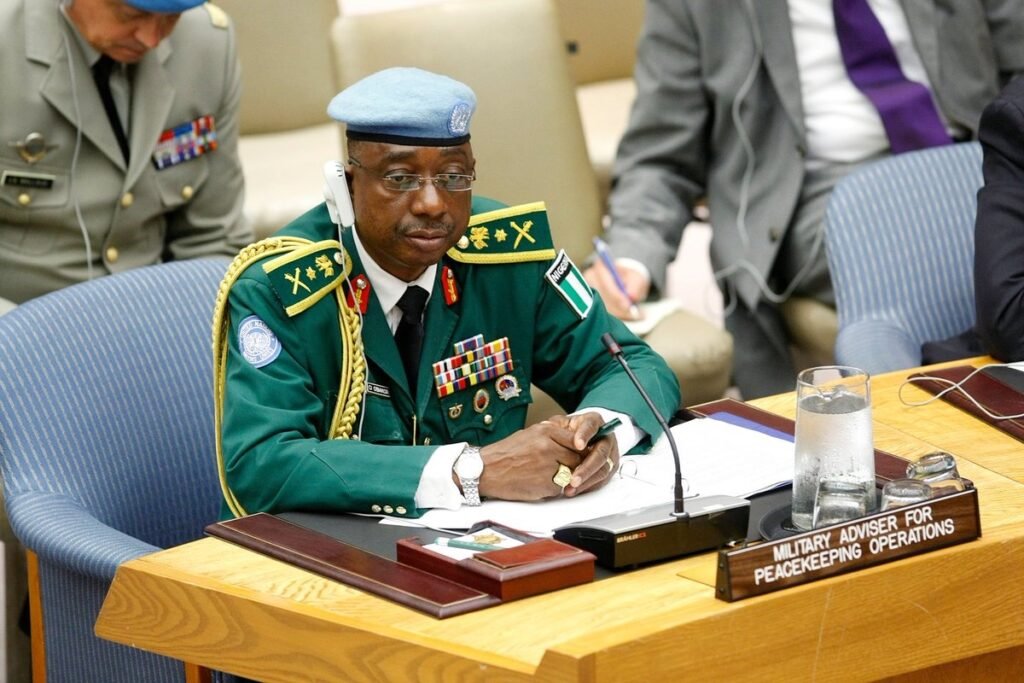
Chikadibia Obiakor biography – Nigerian Lt. General and first African UN Military Adviser dies at 75 in Abuja, May 27, 2026. His wife Meg, career, peacekeeping legacy.
Who Was Lt. Gen. Chikadibia Isaac Obiakor?
Nigeria mourns the death of Lieutenant General Chikadibia Isaac Obiakor (Rtd), one of Africa’s most distinguished military peacekeepers, who passed away on Wednesday, May 27, 2026, at an Abuja hospital. He was 75 years old, having been born on February 18, 1951, in Zaria, Kaduna State.
A retired four-star equivalent military officer who made history as the first African to serve as the UN Military Adviser for Peacekeeping Operations at United Nations Headquarters in New York, Gen. Obiakor’s career spanned nearly four decades of distinguished service. His death was announced by Air Commodore Sani Zakari (Rtd) in a statement that praised him as “widely respected as one of Africa’s most accomplished military peacekeepers and strategic commanders.”
Married to Mrs. Meg Nnenna Obiakor for over 35 years and blessed with children, Gen. Obiakor retired from the Nigerian Army on June 24, 2011, becoming the longest-serving General in recent Nigerian military memory. As a member of the Nigerian Defence Academy’s 10th Regular Course, he outranked and outlasted contemporaries by his unwavering professionalism and strategic brilliance.
His final years were dedicated to international peace work, chairing UN Boards of Inquiry investigating conflicts in South Sudan, Syria, and the Democratic Republic of Congo. The statement announcing his death emphasized: “Throughout his career, he built a reputation for tactical brilliance and strategic leadership in both domestic military governance and global conflict resolution.”
Quick Profile: Lt. Gen. Chikadibia Obiakor (1951-2026)
| Category | Details |
|---|---|
| Full Name | Chikadibia Isaac Obiakor |
| Birth Date | February 18, 1951 |
| Death Date | May 27, 2026 |
| Age at Death | 75 years old |
| Place of Birth | Zaria, Kaduna State, Nigeria |
| State of Origin | Anambra State |
| LGA | Awka South |
| Father | Mr. Robert Echetebu Obiakor |
| Wife | Mrs. Meg Nnenna Obiakor (35+ years) |
| Children | Yes (specific number undisclosed) |
| Military Branch | Nigerian Army |
| Service Years | 1971-2011 (40 years) |
| Final Rank | Lieutenant General |
| NDA Course | 10th Regular Course |
| Highest Position | UN Military Adviser for Peacekeeping |
| National Honour | Officer of the Order of the Federal Republic (OFR) |
| Retirement Date | June 24, 2011 |
| Cause of Death | Undisclosed (hospital in Abuja) |
Early Life: From Zaria to Awka Roots
Birth and Family Background
Chikadibia Isaac Obiakor was born on February 18, 1951, in Zaria, Kaduna State, into the family of Mr. Robert Echetebu Obiakor and Mrs. Obiakor. Though born in northern Nigeria, his ancestral roots trace to Awka South Local Government Area in Anambra State, making him an Igbo by tribe.
His father, Robert Echetebu Obiakor, worked as a fireman at the Nigerian Railway Corporation before transitioning to the Federal Ministry of Works as an Artisan Grade I Engine Driver, Water Works. He served diligently in this capacity until his retirement in 1961, when young Chikadibia was just 10 years old.
This working-class background instilled in young Chikadibia values of discipline, public service, and dedication—qualities that would define his military career. Growing up in Zaria exposed him to Nigeria’s diverse cultural landscape, fostering the detribalised worldview that colleagues would later celebrate.
Childhood in Northern Nigeria
Being born and raised in Zaria during the 1950s placed Obiakor at the heart of Nigeria’s colonial transition. He witnessed the country’s independence in 1960 as a nine-year-old boy, an experience that likely shaped his later commitment to national unity and peacekeeping.
The multicultural environment of Zaria, home to people from across Nigeria’s diverse ethnic groups, gave young Chikadibia exposure to perspectives beyond his Igbo heritage. This early experience proved foundational to his later role as a unifying military figure who transcended ethnic divisions.
Military School and NDA: Foundation of Excellence
Nigerian Military School, Zaria
Obiakor’s military journey began at the prestigious Nigerian Military School (NMS), Zaria—the same institution that would shape generations of Nigeria’s military elite. NMS provided rigorous academic education combined with military training, preparing young men for officer careers in Nigeria’s armed forces.
His time at NMS Zaria created lifelong bonds with fellow students who would later become Nigeria’s military leaders. In September 2017, decades after graduation, he was honoured alongside fellow NMS alumni—Maj. Gen. IBM Haruna (rtd), Col. Musa Shehu (rtd), Col. John Okoli (rtd), and Gp Capt Yakubu Suleiman (rtd)—as Patron of the FCT Chapter of the school’s Alumni Association.
Nigerian Defence Academy (1971)
In 1971, Obiakor entered the Nigerian Defence Academy (NDA) as a member of the prestigious 10th Regular Course. This timing placed him in the academy during Nigeria’s post-civil war reconstruction period, when the military was rebuilding and professionalising.
His NDA cohort included future Nigerian military leaders, though Obiakor would distinguish himself by serving longer and rising higher than most contemporaries. His selection for Course 10—eight courses ahead of future Chief of Army Staff Lt. Gen. Azubuike Ihejirika who joined as Course 18—demonstrated his early entry into Nigeria’s military elite.
Advanced Military Education
Beyond NDA, Obiakor pursued continuous professional development through multiple military training institutions in Nigeria and abroad. His academic pursuits culminated in graduation from the prestigious National War College (now National Defence College) in Abuja, the highest military educational institution in Nigeria.
He further earned a Master of Science degree in Strategic Studies from the University of Ibadan, combining military expertise with academic rigour. This educational portfolio—military training plus civilian academic credentials—uniquely positioned him for senior strategic and diplomatic roles.
Nigerian Army Career: Rising Through the Ranks (1973-2011)
Commission and Early Service
After completing his training at NDA, Obiakor was commissioned into the Nigerian Army in 1973 as a young officer in the artillery corps. His early career involved standard military assignments across various Nigerian Army formations, building the operational experience that would define his later leadership.

The 1970s and 1980s saw him serve in various capacities, developing expertise in artillery operations, military strategy, and command leadership. He demonstrated consistent excellence that earned him steady promotion through the officer ranks.
ECOMOG Operations in Liberia (1996-1997)
Obiakor’s international military career truly began with his deployment to Liberia as part of the Economic Community of West African States Monitoring Group (ECOMOG). From 1996 to 1997, he served as Commander of the ECOMOG Artillery Brigade during Liberia’s brutal civil war.
His ECOMOG service represented Nigeria’s leadership role in West African peacekeeping during a period of regional instability. Nigerian troops formed the backbone of ECOMOG operations, and Obiakor’s leadership in the artillery brigade contributed to the eventual stabilisation of Liberia.
ECOMOG Chief Coordinator of Liberian Elections (July 1997)
In July 1997, Obiakor was appointed ECOMOG Chief Coordinator of the Liberian elections—a critical role overseeing security arrangements for democratic transitions in a war-torn nation. The successful conduct of these elections demonstrated his ability to balance military discipline with diplomatic sensitivity.
This experience proved foundational for his later international career, exposing him to the complex intersection of military operations and political processes that would define modern peacekeeping work.
General Officer Commanding, 2nd Mechanised Division
Upon returning to Nigeria, Obiakor was appointed General Officer Commanding (GOC) of the Second Mechanized Division of the Nigerian Army, headquartered in Ibadan, Oyo State. This prestigious command placed him in charge of one of Nigeria’s most important military formations.
As GOC, Obiakor was responsible for:
- Operational readiness of all units under the 2nd Mechanised Division
- Training and discipline of thousands of troops
- Strategic planning for regional security in southwestern Nigeria
- Resource management across multiple military installations
His successful tenure as GOC demonstrated his capacity for senior command, positioning him for further elevation.
Chief of Administration, Nigerian Army (2001)
In 2001, Obiakor was appointed Chief of Administration of the Nigerian Army, taking responsibility for the welfare, discipline, and medical services for all Nigerian military personnel. This crucial role involved:
- Personnel management for tens of thousands of soldiers and officers
- Healthcare delivery across military hospitals nationwide
- Disciplinary oversight and military justice administration
- Welfare programmes for serving and retired personnel
His work as Chief of Administration earned him reputation as a leader who genuinely cared about troops’ welfare, not just operational outcomes.
UN Service: Making History on the World Stage
Force Commander, UNMIL Liberia (2006)
In January 2006, then-UN Secretary-General Kofi Annan appointed Obiakor as Force Commander of the United Nations Mission in Liberia (UNMIL). This appointment recognised his deep understanding of Liberia from his earlier ECOMOG service combined with his proven military leadership.
As UNMIL Force Commander, Obiakor commanded a multinational force tasked with:
- Maintaining peace in post-conflict Liberia
- Supporting reconstruction and reconciliation
- Training Liberia’s new security forces
- Protecting civilians from continuing violence
His successful leadership of UNMIL caught the attention of UN headquarters, leading to his historic appointment in New York.

UN Military Adviser for Peacekeeping (2008-2010)
In May 2008, UN Secretary-General Ban Ki-moon appointed Obiakor as Military Adviser for Peacekeeping Operations at UN Headquarters in New York. This historic appointment made him the first African to hold this position, marking a watershed moment for African representation at the highest levels of UN peacekeeping.
As Military Adviser and Assistant Secretary-General in the Office of Military Affairs, he:
- Advised the UN Secretary-General on military aspects of peacekeeping
- Coordinated UN military operations across multiple continents
- Worked with troop-contributing countries worldwide
- Shaped UN peacekeeping doctrine and strategy
His tenure brought African perspectives and continental peacekeeping expertise to UN headquarters, influencing how the UN approached conflicts globally. He served in this capacity until 2010, when he prepared for his Nigerian Army retirement.
Retirement from Nigerian Army (June 24, 2011)
Obiakor officially retired from the Nigerian Army on June 24, 2011, after 40 years of service (counting from his NDA entry in 1971). At his retirement, he had become the longest-serving General in recent Nigerian military memory.
He shared with former Chief of Defence Staff General Martin Luther Agwai the distinction of being the highest-ranking officer of the Nigerian military to have served under the United Nations system—a remarkable achievement underscoring his international stature.
Post-Retirement: Continued Service Through UN Inquiry Panels
Chairman, Various UN Boards of Inquiry
Following his Nigerian Army retirement, Obiakor continued contributing to international peace and accountability through chairmanship of UN Boards of Inquiry investigating major conflicts and humanitarian incidents:
2018: Kamanyola Refugee Killings (DRC)
He served as Chairman of the UN Board of Inquiry into the Killing of Burundian Refugees in Kamanyola, Democratic Republic of Congo in 2018. This investigation examined the deaths of refugees who had fled Burundi’s political violence only to face deadly force in their supposed sanctuary.

2019-2020: North West Syria Investigation
He chaired the UN Secretary General’s Board of Inquiry to Investigate the Destruction of Humanitarian Structures and Facilities in North West Syria (2019-2020). This investigation examined attacks on hospitals, schools, and humanitarian facilities during the Syrian civil war.
South Sudan Investigations
He also led UN inquiry panels examining conflicts and humanitarian incidents in South Sudan, contributing his decades of conflict resolution experience to one of Africa’s most devastating crises.
These post-retirement roles demonstrated that Obiakor’s commitment to international peace continued even after formal military retirement. His experience and credibility made him uniquely qualified to lead these sensitive investigations.
Marriage and Family: 35+ Years with Meg
Obiakor was married to Mrs. Meg Nnenna Obiakor for over 35 years at the time of his death—a marriage that began in the early 1980s during his rising military career. Their union was blessed with children, though specific details about their family remained largely private throughout his career.
Mrs. Meg Nnenna Obiakor stood by her husband through his extensive military deployments, international assignments, and the demands of senior command positions. Her support enabled his rise through the Nigerian Army ranks and his international career.

The Obiakors maintained a traditionally private family life, with the General preferring to keep professional and personal matters separate. This privacy aligned with his disciplined military character—focused on service rather than personal publicity.
Decorations and National Honours
Lt. Gen. Obiakor received numerous Nigerian military decorations and the prestigious national honour. His post-nominal credentials included:
Nigerian National Honour:
- OFR – Officer of the Order of the Federal Republic
Military Decorations:
- FSS – Forces Service Star
- MSS – Meritorious Service Star
- DSS – Distinguished Service Star
- CMH – Command of the Order of Merit Honour
- IG – Instructor General
- QS – Qualified Staff
- psc(+) – Passed Staff College (Plus)
- GFISMN – General Fellow of the International Strategic Management
- NPOM – Nigeria Police Order of Merit
These extensive decorations reflected his exceptional service across multiple domains—operational command, peacekeeping, staff work, and international diplomacy.
Death and National Mourning (May 27, 2026)
The Announcement
The news of Lt. Gen. Obiakor’s death came through a statement by Air Commodore Sani Zakari (Rtd) on Wednesday, May 27, 2026, confirming that the distinguished officer had passed away at an Abuja hospital. The statement noted his historic status as “the first African to serve as the UN Military Adviser for Peacekeeping Operations at the UN HQ New York.”
The cause of death has not been publicly disclosed, with the family and military community maintaining their characteristic privacy regarding personal matters.

Tributes Pour In
Following the announcement, tributes flooded in from military officers, diplomats, government officials, and international associates. Common themes in tributes described him as:
A Detribalised Officer – Despite his Igbo heritage, he served Nigeria across all regions and ethnicities, embodying national unity rather than tribal politics.
A Disciplined Leader – His commitment to military discipline and professional standards set examples for generations of younger officers.
A Committed Advocate of Peace – Beyond his military operations, he genuinely believed in conflict resolution and peaceful coexistence.
A National Unity Champion – His career demonstrated commitment to Nigeria’s unity transcending regional and ethnic divisions.
Legacy Reflections
Obiakor’s death prompted reflection on his unique career achievements:
Historical Significance: He broke barriers as the first African UN Military Adviser, paving the way for greater African representation in international peacekeeping leadership.
Service Duration: His 40-year career and longest-serving General status demonstrated rare staying power and consistent excellence.
International Impact: From ECOMOG Liberia to UN headquarters, his work influenced peacekeeping across multiple continents.
Mentorship Legacy: Countless Nigerian and international officers benefited from his guidance and example throughout his career.
Conclusion: A Life Dedicated to Peace and Service
Lieutenant General Chikadibia Isaac Obiakor lived 75 years that traced Nigeria’s modern history—born nine years before independence in colonial Zaria, witnessing the civil war, rising through post-war military reconstruction, and ultimately representing Africa at the highest levels of international peacekeeping.
His career embodied the best aspirations of African military leadership: professional competence, ethical conduct, international engagement, and commitment to peace. From commanding artillery brigades in Liberia’s civil war to advising the UN Secretary-General on global peacekeeping, he demonstrated that African officers could compete and excel at the highest levels of military and diplomatic service.
The path he blazed—from Zaria boy to first African UN Military Adviser—inspired generations of African military officers to pursue international careers and demonstrated that the continent’s military expertise could contribute meaningfully to global peace efforts.
He leaves behind his wife Mrs. Meg Nnenna Obiakor, their children, the Nigerian Army he served for four decades, and an international peacekeeping community that benefited from his wisdom, leadership, and tireless commitment to conflict resolution.
In military terms, Lt. Gen. Chikadibia Isaac Obiakor (OFR) completed his final tour of duty on May 27, 2026. His legacy—written in the peace agreements he helped enforce, the elections he secured, the inquiries he chaired, and the officers he mentored—will continue serving humanity long after his passing.
Rest in peace, General Obiakor (February 18, 1951 – May 27, 2026).