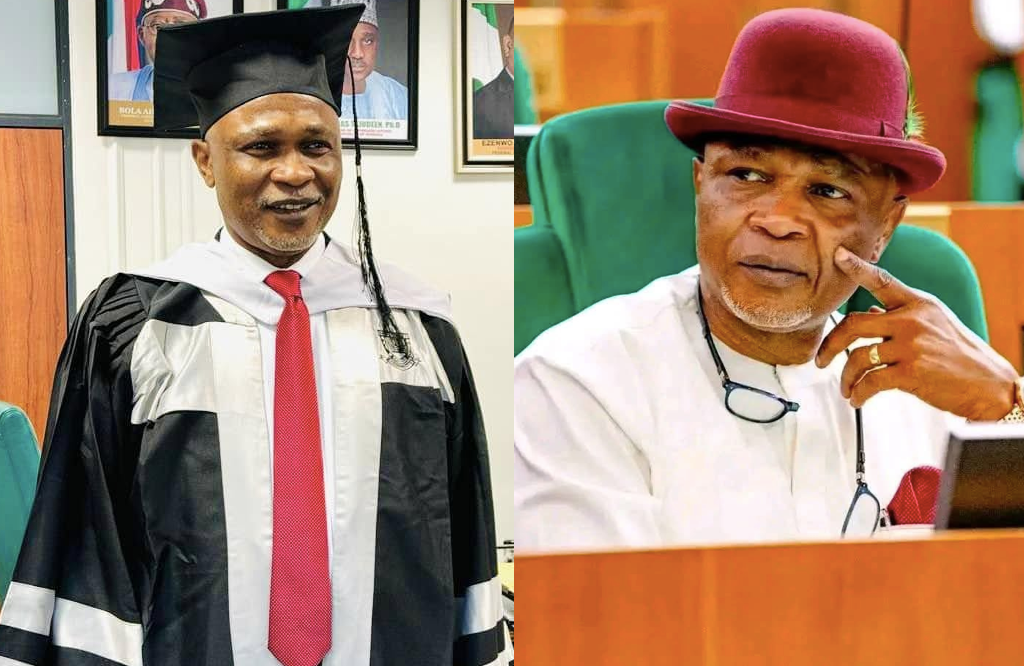
Kingsley Chinda biography – PDP Minority Leader emerges APC Rivers governorship candidate May 21, 2026. Discover his age, wife Beauty, Wike alliance, net worth, and career journey.
Who is Kingsley Chinda Ogundu?
In a stunning political development that unfolded just hours ago on May 21, 2026, Kingsley Ogundu Chinda—the sitting Minority Leader of Nigeria’s House of Representatives and a PDP member—was declared the All Progressives Congress (APC) governorship candidate for Rivers State’s 2027 election. Running unopposed after Governor Siminalayi Fubara and others withdrew, Chinda polled 268,497 votes in what political analysts describe as a Nyesom Wike-orchestrated power play.
Born March 24, 1966 (currently 60 years old in 2026), Chinda represents Obio/Akpor Federal Constituency in Rivers State, a position he’s held since 2011. A lawyer by training and loyalist by reputation, his political career spans over three decades—from student unionism at the National Association of Nigerian Students (NANS) to serving as Rivers State Commissioner for Environment (2007-2010), and now potentially becoming the next Rivers State Governor.
Married to Beauty Azeru Chinda (née Chuku) since 2002, with three daughters—Angel, Kaka, and Iche—Chinda hails from Elelenwo Town in Obio/Akpor LGA. His journey from repeating Primary 1 at Municipal Council School to becoming one of Nigeria’s most powerful legislators demonstrates resilience, political acumen, and controversial party-switching that has shocked the nation.
Quick Profile: Kingsley Chinda Ogundu
| Category | Details |
|---|---|
| Full Name | Kingsley Ogundu Chinda |
| Date of Birth | March 24, 1966 |
| Age (2026) | 60 years old |
| Place of Birth | Elelenwo, Obio/Akpor LGA, Rivers State |
| State of Origin | Rivers State |
| LGA | Obio/Akpor |
| Town | Elelenwo |
| Father | Chief Thompson Worgu Chinda (late) |
| Mother | Caroline Ihuchi Chinda (née Nwaoshor) |
| Wife | Beauty Azeru Chinda (married 2002) |
| Children | Three daughters (Angel, Kaka, Iche) |
| Education | LL.B (Rivers State University), BL (Nigerian Law School) |
| Current Position | House of Reps Minority Leader (PDP) |
| Constituency | Obio/Akpor Federal Constituency |
| Years in House | Since 2011 (15+ years) |
| Latest Achievement | APC Rivers Governorship Candidate (May 21, 2026) |
| Political Godfather | Nyesom Wike (FCT Minister) |
| Religion | Christianity |
Historic APC Governorship Victory (May 21, 2026)
The Shocking Primary Results
At approximately 6:00 PM West African Time on Thursday, May 21, 2026, Bitrus Kwamoti—Chairman of the APC Governorship Primary Election Committee—declared Kingsley Chinda the party’s Rivers State governorship candidate at the APC Secretariat in Port Harcourt.
Kwamoti announced: “I, Kwamoti Bitrus, chairman of the Governorship Primary Election Committee, hereby certify that I am the Returning Officer for the Rivers State Governorship Primary Election held on this 21st day of May, 2026. The name of the aspirant, who is the sole aspirant, is Chinda Ogundu Kingsley. He scored the total number of votes, 268,497.”
The figure represented APC faithful who voted across all 23 local government areas of Rivers State, delivering an unopposed victory that solidifies Chinda’s position as Wike’s preferred candidate.
The Strategic Withdrawals
The path to Chinda’s victory was paved by dramatic withdrawals on Wednesday, May 20, 2026:
Governor Siminalayi Fubara withdrew from the APC primary, claiming his decision followed “deep reflection and consultations” and represented “conviction and sacrifice for the state to move forward in peace and unity.” However, sources suggest he appeared “visibly downcast” after his screening, fuelling speculation that the committee had effectively disqualified him.
Tonye Cole, a prominent businessman and previous APC governorship candidate, also withdrew from the race.
Dax George-Kelly (also known as Alabo Dakorinama George Kelly), a former Commissioner for Works and Wike ally, withdrew despite earlier reports in early May 2026 suggesting Wike had shifted his anointing from Chinda to George-Kelly after consultations with former militant leaders Asari Dokubo and Ateke Tom.
Chinda’s Victory Speech
Speaking after his declaration, Chinda promised Rivers residents: “If elected governor, I will govern with fear of God and respect for the rule of law. Rivers people should expect sincerity in governance and proper accountability. Peaceful and progressive Rivers State is coming again.”
The Wike Factor
Political observers universally acknowledge this victory as orchestrated by Nyesom Wike, Nigeria’s powerful FCT Minister and former Rivers Governor (2015-2023). Throughout screening exercises for Assembly, House of Representatives, and Senate aspirants, politicians loyal to Fubara were systematically disqualified while Wike-aligned aspirants sailed through effortlessly.
This development represents Wike’s continued dominance over Rivers politics despite being out of state office for three years, demonstrating his ability to manipulate party structures across PDP and APC lines through his “Rainbow Coalition”—an alliance of members from both parties loyal exclusively to him.
Early Life: From Humble Beginnings to Political Powerhouse
Kingsley Ogundu Chinda was born on March 24, 1966, in Elelenwo Town, Obio/Akpor Local Government Area of Rivers State. He hails from the Chidamati family in Rumuodikirike Compound, Rumuodani Community—a lineage that would later provide his political base.
His father, Chief Thompson Worgu Chinda, and mother, Caroline Ihuchi Chinda (née Nwaoshor), provided him with modest beginnings. However, Chinda’s childhood took an unusual turn when he didn’t live with his biological parents but instead grew up under the tutelage of pseudo-parents.
Raised by Half-Sister
After starting Primary 1 at St. Marks State School Elelenwo, young Kingsley left for Port Harcourt city where he lived with his half-sister, Chief (Barr.) Mrs. Eunice Nnenda Ogan. This move to the city exposed him to opportunities unavailable in his rural hometown.
In 1972, he repeated Primary 1 at Municipal Council School I, Orogbum along Agudama Street in D/Line, Port Harcourt—a fresh start that would set the foundation for academic success. He graduated from primary school in 1978 “in top colours,” having served as class prefect throughout his primary school days. His favourite primary school teacher was Mrs. Ndiomu, whose influence helped shape his early development.
Secondary Education Excellence
Chinda gained admission to the prestigious Stella Maris College, Port Harcourt in 1979. During his secondary years, he was described as studious and disciplined, qualities that would serve him throughout his legal and political career.
It was during this period that Chinda began developing a compassionate view towards society, observing that “all persons were not given fair and equal opportunity by nature.” This social consciousness would later inform his political ideology and drive his advocacy for marginalized communities.
Tertiary Education Journey
After secondary school, Chinda pursued further education at the Rivers State School of Basic Studies between 1984-1986, where he obtained his Advanced Level Certificate. This qualification granted him direct entry into the Rivers State University of Science & Technology, Nkpolu, Port Harcourt (now Rivers State University).
He graduated with a Third Class degree in Law—a modest academic performance that didn’t prevent him from pursuing legal practice and building an extraordinary political career. While at university, Chinda was active in student unionism, gaining national recognition as a senate member of the National Association of Nigerian Students (NANS). He became the fulcrum of the NANS movement within the South-South, building networks that would later prove invaluable in politics.
After graduating, he attended the Nigerian Law School, Lagos, and was called to the Nigerian Bar, becoming a certified legal practitioner.
Legal Career: Building Foundations in Law
Early Practice in Benin City
After law school, Chinda relocated to Benin City, Edo State, where he joined a law firm and began private legal practice. During this period, he started a weekly radio programme titled “YOU AND THE LAW” where he exposed common but burning legal issues affecting society.
Topics included:
- Police and Society: Right of Arrest and Trial
- Landlord and Tenant matters
- Consumer rights
- Human rights violations
This radio programme brought him to the limelight in Benin City, establishing his reputation as a people’s lawyer who prioritized public legal education over commercial gain.
Return to Port Harcourt
In 1996, Chinda returned to Port Harcourt to practice law with the firm C.A.W. CHINDA & CO., where he served tutelage for approximately two years under the guidance of Chief (Barr.) & Mrs. C.A.W. Chinda—another set of pseudo-parents who raised him during his teenage years.

Founding Onyeagucha, Chinda & Associates
Around 1998, Chinda decided to venture into Environmental and Human Rights Litigation alongside a longstanding school friend, Hon. Uche Onyeagucha. Together they founded ONYEAGUCHA, CHINDA & ASSOCIATES, a law firm that would become prominent in Rivers State legal circles.
The firm operates offices in Port Harcourt, Owerri, and Abuja, and Chinda currently serves as Principal Partner. Throughout his private practice years, he:
- Handled several pro bono cases for indigent and oppressed persons
- Clearly rejected briefs from oil giants (maintaining independence from petroleum company influence)
- Refused matrimonial matters (divorce cases), focusing instead on human rights and environmental justice
This selective practice demonstrated his commitment to using law as a tool for social justice rather than pure commercial gain—a reputation that enhanced his political appeal.
From Law to Politics: The Political Journey Begins
Early Political Involvement (1999-2007)
Chinda’s formal political career began in 1999 when he served as Legal Adviser to the Grassroots Democratic Movement and later to the Peoples Democratic Party (PDP) in Obio/Akpor LGA from 1999-2004. This five-year period provided him with deep understanding of grassroots politics and party machinery.
From 2005-2007, he served as Legal Adviser to Obio/Akpor Local Government Council, gaining administrative experience and building relationships with local power brokers who would later support his legislative ambitions.
Commissioner for Environment (2007-2010)
In 2007, Chinda was appointed Rivers State Commissioner for Environment under Governor Chibuike Rotimi Amaechi’s administration. This three-year stint in executive government provided him with:
- Experience managing state-level environmental policies
- Understanding of Rivers State’s complex petroleum-related environmental challenges
- Visibility among state bureaucrats and political elites
- Resources to expand his political network
His performance as Environment Commissioner positioned him favourably for a run at federal legislature, which materialized in 2011.
Legislative Career: Rising Through the House of Representatives
First Election Victory (2011)
In April 2011, Chinda contested and won the Obio/Akpor Federal Constituency seat on the PDP platform. His victory marked the beginning of what would become a 15+ year tenure representing one of Rivers State’s most strategic constituencies.
Obio/Akpor is particularly significant because it includes:
- Parts of Port Harcourt, the state capital
- Industrial areas with significant economic activity
- Oil-rich communities facing environmental degradation
- Diverse ethnic populations requiring delicate political balancing
Re-elections and Consolidation (2015, 2019, 2023)
Chinda successfully defended his seat in:
- 2015 general elections
- 2019 general elections
- 2023 general elections
Each victory strengthened his political machinery and demonstrated his constituency’s satisfaction with his representation. His consistent re-election reflects both personal popularity and effective patronage distribution to local communities.
Chairman, Public Accounts Committee
One of Chinda’s most celebrated legislative achievements was serving as Chairman of the Public Accounts Committee in a previous National Assembly session. This powerful committee oversees government expenditure and holds ministries accountable for financial irregularities.
As Chairman, Chinda earned recognition for legislative excellence and thorough oversight, investigating budget implementation and exposing wasteful spending. This role enhanced his reputation as a serious legislator beyond mere constituency representation.
Minority Leader (10th Assembly)
Following the 2023 general elections that returned APC as the ruling party, the PDP caucus in the House of Representatives elected Chinda as Minority Leader of the 10th Assembly—one of the most powerful opposition positions in Nigerian politics.
As Minority Leader, his responsibilities include:
- Leading PDP caucus strategy in legislative debates
- Coordinating opposition responses to government policies
- Negotiating with Speaker and majority leadership on legislative agenda
- Representing opposition perspective in major national discussions
This position placed him at the centre of Nigerian political discourse, elevating his profile beyond Rivers State to national prominence.
Marriage and Family Life
Finding “His Missing Rib”
In 2002, Kingsley Chinda “found his missing rib right in his community, Elelenwo,” according to his biography. He married Miss Beauty Azeru Chuku (now Mrs. Beauty Azeru Chinda), a woman from his hometown.
Their marriage represents a union rooted in shared community ties and cultural background. The couple has been married for 24 years as of 2026, maintaining a stable family life despite the demands of Chinda’s political career.
Three Daughters
The Chinda family has been blessed with three daughters:
- Angel Chinda
- Kaka Chinda
- Iche Chinda
Chinda’s biography affectionately describes them as “three pretty daughters,” and they remain largely out of the public spotlight, consistent with his preference for keeping family life private despite public political prominence.
Personal Values
Those who know Chinda describe him as a devoted family man who balances political demands with family responsibilities. His hobbies include:
- Reading (particularly legal and political texts)
- Teaching (he maintains connections with legal education)
- Community engagement in Elelenwo
The Wike Alliance: Power and Controversy
The Rainbow Coalition
Chinda’s most controversial political relationship is his alliance with Nyesom Wike, which operates through what insiders call the “Rainbow Coalition”—a political structure of PDP and APC members loyal to Wike operating across party lines.
This arrangement allows Wike to maintain control over Rivers politics despite serving as FCT Minister in an APC federal government while his loyalists like Chinda remain nominally in PDP positions but work toward APC objectives at the state level.
The Governorship Chess Match
Throughout early 2026, Chinda’s name circulated as Wike’s preferred candidate for Rivers State governorship on the PDP ticket under the Rainbow Coalition framework. However, the situation grew complicated when:

March-April 2026: Speculation mounted about Chinda becoming Wike’s heir apparent while simultaneously serving as PDP Minority Leader—a position that should make him Wike’s opponent, not ally.
May 2026: Reports emerged that Wike had shifted his anointing from Chinda to Alabo Dakorinama George-Kelly after consultations with former militant leaders Asari Dokubo and Ateke Tom, leaving political watchers questioning whether Chinda had been quietly set aside after being used to create noise.
May 21, 2026: In a dramatic reversal, Chinda purchased APC governorship nomination forms, George-Kelly withdrew, and Chinda emerged as the sole APC candidate—revealing this had been the plan all along.
December 2025 Award Amid Controversy
In December 2025, Chinda was honoured with the Leadership Award for Integrity, Stewardship and Transparency in Public Service by the Centre for Credible Leadership and Citizens Awareness.
He dedicated the award to the Nigerian people, describing the moment as “a call for sober reflection given the state of the country.” Critics viewed this award skeptically given his simultaneous manoeuvring between PDP and APC, questioning what “integrity” means when serving as opposition leader while working for the ruling party’s interests.
Net Worth and Financial Profile
While Chinda’s exact net worth remains undisclosed, multiple income sources over 15+ years in the House of Representatives have built substantial wealth:
Legislative Salary: Nigerian House of Representatives members receive competitive salaries, allowances, and benefits including housing, transportation, and constituency project funds.
Legal Practice: As Principal Partner at Onyeagucha, Chinda & Associates with offices in three cities, he continues earning from legal practice despite legislative commitments.

Political Patronage: Connections to powerful figures like Wike provide access to contracts, appointments, and other financial opportunities common in Nigerian politics.
Estimated Range: Political analysts estimate his net worth between ₦200 million to ₦500 million ($240,000 – $600,000 USD), though this remains speculative without financial disclosure.
Political Controversies and Criticisms
The Party Loyalty Question
Chinda’s simultaneous service as PDP Minority Leader while emerging as APC governorship candidate raises fundamental questions about party loyalty and political integrity. Critics argue he has:
- Betrayed PDP members who elected him Minority Leader expecting opposition to APC
- Misled the public about his true political allegiances
- Abused his position by using opposition platform to advance ruling party interests
The Fubara Humiliation
Many Rivers residents view Chinda’s emergence as deliberate humiliation of a sitting governor by his own party machinery. The systematic disqualification of Fubara loyalists while Wike allies sailed through screening demonstrates:
- Erosion of democratic norms within party primaries
- Godfather politics superseding merit and popular will
- Potential long-term resentment among sections of Rivers electorate
The Riverine Axis Concern
Political analysts warn that perceived humiliation of Governor Fubara—who represents the riverine axis—violates Rivers State’s informal power rotation understanding between upland and riverine communities. This could trigger:
- Ethnic tensions between different sections of the state
- Defections by aggrieved Fubara loyalists to opposition platforms
- Electoral violence if perceived as upland domination
Looking Ahead: The 2027 Rivers Governorship Race
Current Political Landscape
As of May 21, 2026, the Rivers governorship picture includes:
APC: Kingsley Chinda (official candidate)
PDP: To be determined (primary yet to hold)
Other Parties: Various candidates from smaller parties
Chinda’s Chances
Election forecasters consider the race highly competitive despite Chinda’s Wike backing because:
Advantages:
- Wike’s powerful political machinery
- APC federal government support
- Access to significant campaign resources
- Name recognition from 15+ years as federal legislator
Challenges:
- PDP’s traditional strength in Rivers State
- Resentment over party-switching and Fubara treatment
- Potential backlash from riverine communities
- National political dynamics affecting state elections
The Uncertainty Factor
Political observers note that Nigeria’s 2027 elections occur amid:
- Economic hardship affecting voter priorities
- Security challenges in various regions
- Potential constitutional amendments affecting electoral processes
- Unknown factors that could reshape the race before 2027
Conclusion: A Political Career at Crossroads
Kingsley Chinda Ogundu stands at the most critical juncture of his six-decade life and three-decade political career. His emergence as APC Rivers governorship candidate represents either the culmination of strategic political manoeuvring or the beginning of his most difficult battle.
From repeating Primary 1 at Municipal Council School to potentially becoming Rivers State Governor, his journey demonstrates resilience, political acumen, and the complex realities of Nigerian politics where loyalty, alliances, and godfatherism often matter more than ideology or party platforms.
His relationship with Nyesom Wike—serving as PDP Minority Leader while advancing APC gubernatorial ambitions—epitomizes the fluidity of Nigerian political allegiances and raises questions about the very meaning of opposition politics.
As Rivers State heads toward the 2027 governorship election, Chinda’s victory or defeat will determine whether his controversial party-switching gamble was political genius or career-ending miscalculation. Whatever the outcome, his story will remain a case study in Nigerian political pragmatism, godfatherism, and the lengths politicians will go to secure power.
For now, the 60-year-old lawyer, legislator, and loyalist awaits judgment not from party structures or political godfathers, but from Rivers State voters who will ultimately decide if his promise of “peaceful and progressive Rivers State” outweighs concerns about his circuitous path to the APC candidacy.